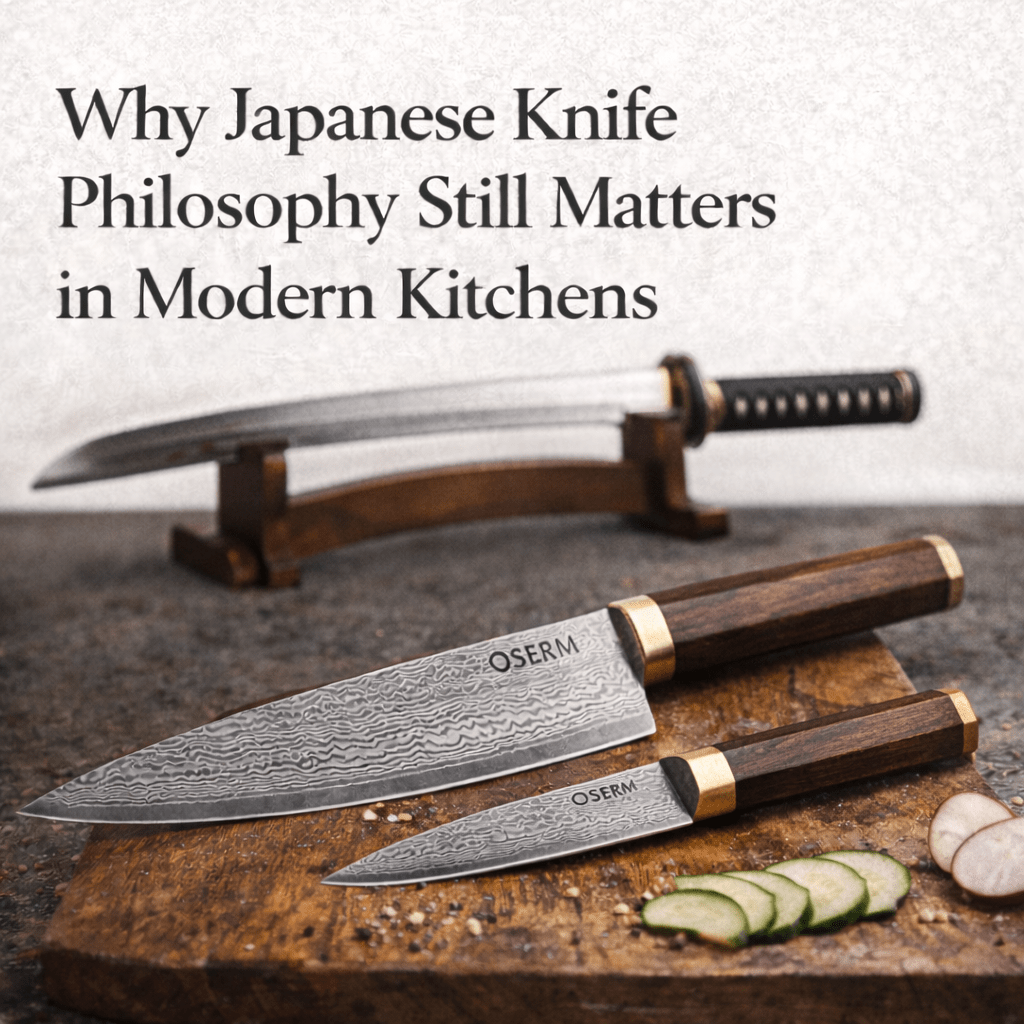
Why Japanese Knife Philosophy Still Matters in Modern Kitchens
In a world driven by speed, convenience, and disposability, it is easy to forget that some tools were never meant to be rushed.
Japanese knife philosophy was born from patience, restraint, and respect — values that feel increasingly rare, yet deeply needed, in modern kitchens.
At OSERM, our knives are not replicas of tradition. They are continuations of it — adapted for contemporary life, while preserving the spirit that made Japanese blades timeless.
1. Japanese Knives Were Never About “More”
One of the most misunderstood aspects of Japanese knife culture is its relationship with minimalism.
Traditional Japanese kitchens did not rely on excessive tools. Instead, they emphasized:
- precision over force
- intention over speed
- mastery over abundance
Every knife had a purpose. Every cut had meaning.
This philosophy aligns naturally with modern kitchens, where clarity and efficiency matter more than ever.
2. Respect for Ingredients Is the Core Philosophy
Japanese knife philosophy begins not with steel, but with ingredients.
The goal of the blade is not domination — it is cooperation. A good knife honors the natural structure of food, preserving texture, moisture, and integrity.
This is why Japanese-inspired knives are known for:
- clean, precise cuts
- minimal cellular damage
- better visual and textural results
In modern cooking, where freshness and presentation matter deeply, this approach remains profoundly relevant.
3. Craftsmanship as a Quiet Discipline
Japanese blade-making has always treated craftsmanship as a discipline rather than a display.
True quality is not loud. It reveals itself over time — through balance, consistency, and trust.
This is why traditional techniques emphasize:
- layered steel construction
- careful heat treatment
- hand-guided finishing
OSERM carries this mindset forward by combining VG-10 Damascus steel with modern precision, creating blades that feel refined rather than aggressive.
4. Why This Philosophy Fits Modern Life Better Than Ever
Modern kitchens are shared spaces. They are used daily, often by multiple people, under time constraints.
Japanese knife philosophy fits this reality because it prioritizes:
- control over brute force
- comfort over intimidation
- flow over effort
A well-balanced knife reduces fatigue, improves confidence, and makes cooking feel calmer — not more complicated.
5. Minimalism Is Not a Trend — It Is a Principle
Minimalism in Japanese culture is not about having less for the sake of aesthetics. It is about removing what interferes with function.
In knife design, this means:
- clean blade geometry
- purpose-driven shapes
- handles designed for long-term comfort
This is why OSERM knife sets focus on essential blades, thoughtful combinations, and real-world usability — not decorative excess.
6. The Modern Interpretation: OSERM’s Perspective
OSERM does not aim to imitate historical Japanese knives.
Instead, we translate the philosophy into modern needs:
- VG-10 Damascus steel for durability and edge retention
- ergonomic handles for contemporary kitchens
- balanced knife sets for shared cooking
- gift-ready presentation for modern lifestyles
It is tradition without rigidity — respect without nostalgia.
7. Why Philosophy Matters When Choosing a Knife Set
Tools shape habits.
A knife that encourages precision changes how you cut. A knife that feels balanced changes how long you cook. A knife designed with restraint changes how you approach the kitchen.
This is why philosophy matters — even if it is not consciously noticed at first.
8. A Quiet Influence That Lasts
Japanese knife philosophy does not demand attention.
It simply works — quietly, consistently, and beautifully.
In modern kitchens filled with noise, screens, and urgency, this quiet influence is more valuable than ever.
Weekly Deal 🔥
Explore OSERM 3+1, 5+1, and 7+1 Knife Sets — inspired by Japanese philosophy, crafted for modern kitchens, and designed to last.
You Might Also Like
- How Long Should a Good Knife Set Last?
- How to Care for a Knife Set
- 3+1 vs 5+1 vs 7+1 – Which Knife Set Fits Your Life?
Tags: Japanese knife philosophy, OSERM knives, Damascus kitchen knives, minimalist kitchen tools, knife craftsmanship