The Weight That Guides the Hand – Why a Knife’s Balance Shapes the Way We Cook
Every knife has a personality. Some glide gently. Others press with authority. Some encourage speed, while others invite reflection. Much of this character comes from weight — the quiet force that guides the hand, steadies the motion, and defines how the blade interacts with the world.
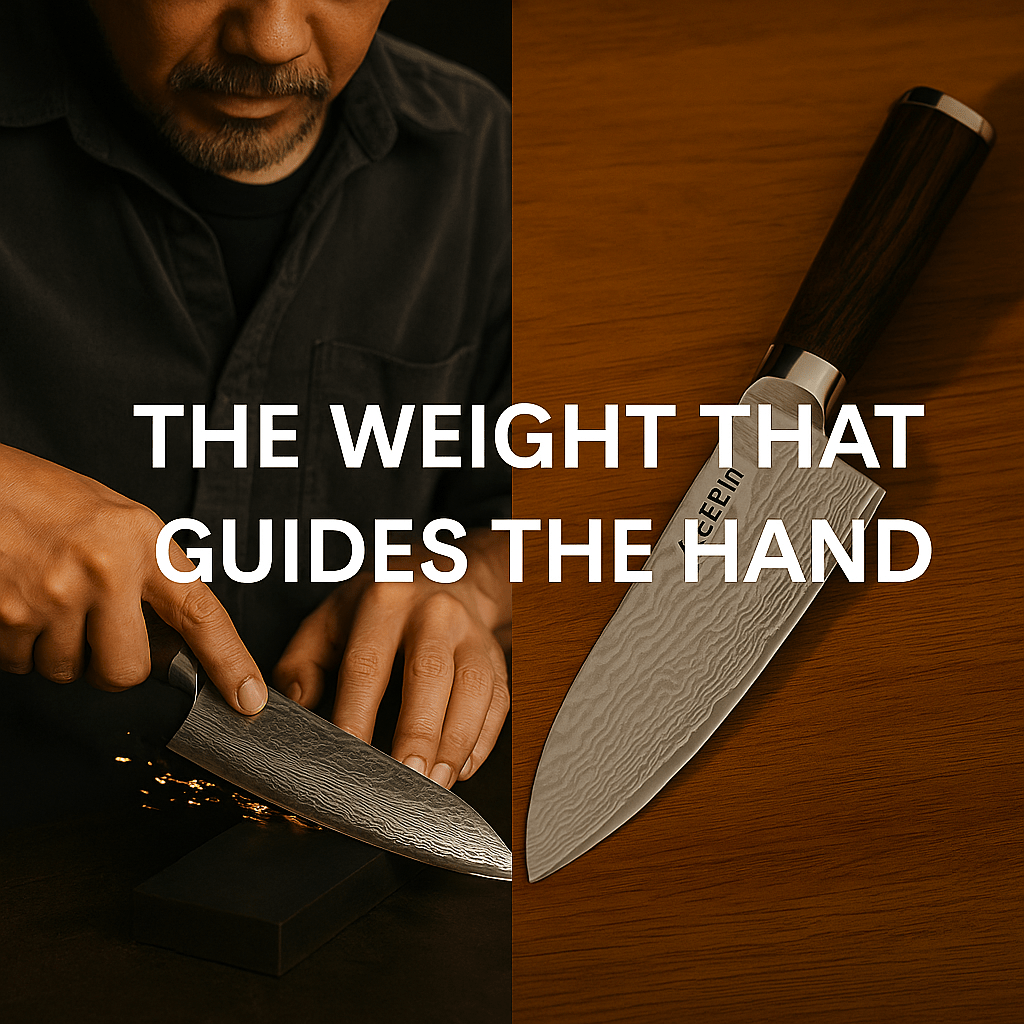
In OSERM’s approach to knife-making, weight is not merely mass. It is emotion, intention, and philosophy. A well-balanced Damascus knife becomes an extension of your body — allowing movements that feel both intuitive and expressive. The right weight doesn’t just cut better; it makes you feel better while cooking.
1. Weight as a Form of Communication
Most people think of knives in terms of sharpness, steel type, or edge geometry, but professionals know that the soul of a knife lies in its weight distribution. A well-balanced knife “talks” to you. It tells you where to move, how fast to move, when to press, and when to glide.
When you hold an OSERM blade, you feel this conversation immediately — a subtle dialogue between steel and hand. The knife doesn’t overpower you, nor does it disappear; it supports you. That balance is what makes cutting feel more like a craft and less like a task.
2. Balance: The Intersection of Physics and Emotion
A knife that is too blade-heavy feels aggressive — strong for chopping, but fatiguing over time. A handle-heavy knife may feel nimble but unstable. OSERM knives are crafted to strike the center — a harmony point where strength meets grace.
This harmony is felt in:
- Stability during long slicing motions
- Control when handling delicate ingredients like herbs or fish
- Confidence when cutting through dense textures
- Comfort during extended cooking sessions
Good balance reduces both tension and error. The body relaxes. Movements become fluid. Cooking transitions from effort to expression.
3. The Hidden Craft Behind OSERM’s Weight Design
Every OSERM handle is shaped not just for beauty but for equilibrium. The resin-and-wood blend is chosen for its density, its tactile warmth, and its emotional presence. Subtle curves allow your hand to anchor without strain. The VG-10 Damascus blade adds forward stability without overwhelming your wrist.
The result is a knife that feels alive — solid enough to be trusted, light enough to feel graceful.
4. Weight Shapes Rhythm
Each cook develops a natural rhythm, a tempo in the kitchen. Some chop quickly, some glide slowly. The knife becomes the metronome.
A well-balanced OSERM blade helps refine your rhythm:
- Smoother transitions from ingredient to ingredient
- More consistent slices with less force
- A grounded pace that feels calming rather than rushed
- A cleaner connection between your intention and the outcome
When a knife aligns with your natural rhythm, cooking feels not like execution, but like flow.
5. Weight Affects not Just Movement, but Mindset
The moment you grip a well-balanced knife, your mind shifts. You become more present, more deliberate. The weight reminds you to slow down, to pay attention, to appreciate the materials in front of you. It’s a grounding sensation — one that brings you back to your senses.
This is why chefs often say their favorite knife “calms” them. Weight can be emotional. A balanced knife creates a balanced mind.
6. When Weight Becomes Tradition
In Japanese knife-making, weight is never accidental. It carries the legacy of the smith, the rhythm of the workshop, and the philosophy of craft. OSERM’s design draws from this lineage — honoring the idea that a tool should harmonize with the human hand.
When you lift an OSERM knife from its signature orange gift box, you feel this lineage. The weight isn’t just physical mass — it is the heritage of craftsmanship, condensed into form.
7. Choosing the Right Weight for You
There is no single perfect weight; there is only the weight that feels right for you. Some cooks prefer a blade-forward balance for confident chopping. Others prefer a lighter touch for precision slicing. OSERM’s Damascus knives aim to meet both ends — strong enough to anchor, refined enough to glide.
If a knife feels like it moves with you, rather than against you, you’ve found the right one.
Weekly Deal 🔥
Experience the balance that defines OSERM craftsmanship. Our Damascus Knife Collection offers blades that combine weight, rhythm, and control — crafted to elevate every movement in the kitchen.
You Might Also Like
- The Rhythm of the Blade – Knife Flow and Cooking Tempo
- The Texture of Life – Understanding Ingredients Through Touch
- The Hands That Shape the Blade – Craftsmanship in Motion
Tags: OSERM Damascus knives, knife balance, craftsmanship, VG-10 steel, cooking rhythm, weight distribution, Japanese design, orange gift box